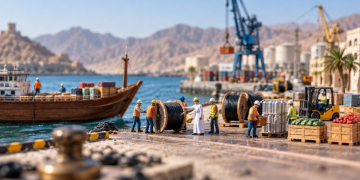
Sheikh Mohammed bin Rashid Al Maktoum announced the figure on 8 November 2026. Trade rose 10% year on year, per the same announcement. Exports to the UAE’s ten largest trading partners surged 31% over the same period.

The figures
| 10 | Nine-month non-oil trade growth, year on year Sheikh Mohammed bin Rashid Al Maktoum announcement, 8 November 2026 |
| 31 | Export surge to UAE’s ten largest trading partners Sheikh Mohammed bin Rashid Al Maktoum announcement, 8 November 2026 |
Source: Sheikh Mohammed bin Rashid Al Maktoum announcement, 8 November 2026
The result signals sustained momentum across the UAE’s trade network. It also gives logistics, ports and trade-finance investors a clearer picture of demand.
Export growth gives the UAE more room to manoeuvre
The first half of 2026 had already pointed to strong momentum. Non-oil foreign trade reached Dh1.937tn in H1 2026, up 13.1% year on year, according to UAE government data. Non-oil exports set a record of Dh452.8bn in the same period — a 23.9% annual increase.
By FurtherArabia’s reading of the numbers, export growth now matters as much as headline trade volume. The pace at which non-oil exports are expanding signals a structural shift, not a cyclical bounce.
Trade routes held up despite geopolitical pressure in the region. The expansion of eastern UAE logistics networks has played a direct role in sustaining continuity when maritime access faced strain. Diversified routing is now a measurable competitive advantage.
What do UAE trade agreements mean for investors?
The UAE has extended market access through its Comprehensive Economic Partnership Agreement (CEPA) programme. Agreements now cover 40 countries, opening preferential terms across major export destinations.
For companies, CEPAs reduce friction across supply chains. They also support decisions on distribution, manufacturing and re-export. The UAE-Indonesia trade corridor illustrates how quickly new corridors can scale once an agreement is in place.
As trade agreements multiply, the case for UAE-based regional distribution strengthens. Infrastructure investors are already responding.
GDP and the non-oil economy hold steady
Economic activity remained resilient alongside trade. Real GDP reached Dh961.9bn at constant prices in H1 2026, up 0.4% year on year, according to UAE government data.
Non-oil GDP grew 1.8% year on year. That lifted non-oil activities’ share of the economy to 79.2% from 78.1%, per Federal Competitiveness and Statistics Centre data for 2026. The table below summarises the key indicators from that government source.
| Indicator | H1 2026 figure | Year-on-year change |
|---|---|---|
| Non-oil foreign trade | Dh1.937tn | +13.1% |
| Non-oil exports | Dh452.8bn | +23.9% |
| Real GDP (constant prices) | Dh961.9bn | +0.4% |
| Non-oil GDP growth | — | +1.8% |
| Non-oil share of GDP | 79.2% | +1.1pp |
Meanwhile, trade corridors and supporting infrastructure continue to attract capital. Those assets gain value as agreements expand and exporters access more markets.
Investors should track the next quarterly trade release, further CEPA activations, and traffic volumes on the UAE’s eastern maritime corridors.
What it means for the Gulf
A nine-month trade figure approaching Dh3tn, up 10% year on year, reinforces the UAE’s role as the region’s principal re-export and distribution platform. For Gulf investors, the 31% surge in exports to the UAE’s ten largest trading partners is the more instructive signal: it suggests that CEPA-linked corridors — such as the US$6.1B UAE-Indonesia corridor and the US$5.4B UAE-Brazil trade corridor — are generating measurable volume, not merely diplomatic goodwill.
For logistics and manufacturing operators, the non-oil GDP share rising to 79.2% supports the case for UAE-based regional capacity. DHL’s €500M Gulf investment commitment through 2030 and Adnoc’s US$16.3B local manufacturing supplier drive both sit within an economy whose structural diversification is now reflected in the trade data.
Quick answers
UAE foreign trade approached Dh3tn (nearly US$817bn) in the first nine months of 2026, a 10% increase year on year, according to an announcement by Sheikh Mohammed bin Rashid Al Maktoum on 8 November 2026.
Non-oil exports reached a record Dh452.8bn in the first half of 2026, up 23.9% year on year, per UAE government data. Non-oil foreign trade for the same period rose 13.1% to Dh1.937tn.
The CEPA programme is the UAE’s framework for securing preferential trade terms with partner countries. Agreements now cover 40 countries, reducing supply-chain friction and supporting export, manufacturing and re-export decisions for companies based in the UAE.