A corridor strategy takes shape
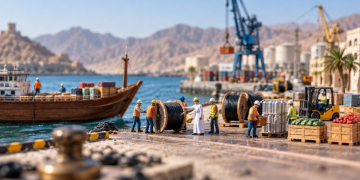
DHL Global Forwarding is targeting stronger positions near Khor Fakkan and Dibba in Fujairah. Tobias Maier, the company’s regional head, confirmed the eastward focus to The National in November 2026. The move is a direct response to cargo rerouting pressures that have added port calls, land movements and fuel costs across Gulf trade lanes.
Capacity remains tight. Vessel waiting times have lengthened. Operators are managing more complex logistics chains with little room for error.
DHL’s answer is network optionality. By spreading infrastructure across multiple eastern UAE gateways, the company reduces its exposure to any single point of congestion.
Eastern ports as strategic alternatives
The timing aligns with wider port development in the region. DP World reached an agreement in principle with the Fujairah Ports Authority to develop terminals at Al Rugaylat and Dibba under a 50-year concession. That deal gives logistics investors a clearer signal: the UAE is adding maritime redundancy, and global operators are positioning accordingly.
DHL’s broader commitment to the Middle East spans more than €500 million between 2024 and 2030, per The National’s November 2026 report. The programme covers four DHL divisions and focuses on Saudi Arabia and the UAE. Announced facility investments include €120 million in the UAE and €130 million in Saudi Arabia, both part of that regional envelope.
By FurtherArabia’s reading of the figures, these commitments show DHL is building long-cycle infrastructure, not reacting to short-term volume swings. The scale places DHL alongside other major operators deepening their UAE infrastructure stakes, a pattern also visible in the broader UAE trade corridor investment drive.
| Investment or partnership | Value or term |
|---|---|
| DHL Middle East programme (2024–2030) | More than €500M (The National, November 2026) |
| UAE facility investment | €120M (DHL announced programme) |
| Saudi Arabia facility investment | €130M (DHL announced programme) |
| Etihad Rail freight partnership | 20 years (announced 2023) |
What does the DHL Etihad Rail deal mean for investors?
DHL Global Forwarding and Etihad Rail announced a 20-year joint-venture agreement in 2023 to move freight across the UAE National Rail Network. The partnership connects maritime gateways to inland distribution. It also gives DHL an alternative corridor when vessel schedules or port access shift.
Maier said GCC plans remain unchanged and that the company will continue to invest. He added that UAE government work on alternative shipping routes strengthens the country’s long-term strategic position.
The DHL–Etihad Rail deal signals that resilient multi-modal infrastructure, not port capacity alone, is now the competitive differentiator for Gulf logistics operators.
What comes next for UAE freight infrastructure?
The eastern UAE expansion carries significance beyond DHL’s own footprint. It aligns a global freight operator with port development and national rail infrastructure simultaneously. For corporate freight users, this could widen routing choices and reduce dependence on a single maritime corridor — a dynamic also reflected in the DIP Holding IPO, which raised up to US$543 million to deepen Dubai’s industrial and logistics ecosystem.
The next watchpoints are project-level announcements near Khor Fakkan and Dibba, the pace of DP World’s terminal development under its Fujairah concession, and any further DHL divisional commitments within the 2024–2030 programme.
What it means for the Gulf
DHL’s eastward push into Fujairah, backed by more than €500 million across the region through 2030, reinforces a pattern of long-cycle infrastructure commitment that Gulf investors are tracking closely. The DP World concession at Al Rugaylat and Dibba adds a second layer of maritime redundancy, and the 20-year DHL–Etihad Rail partnership suggests operators are building multi-modal depth rather than simply expanding port capacity. This mirrors the industrial logic behind the DIP Holding IPO, which raised up to US$543 million to strengthen Dubai’s logistics ecosystem.
For Gulf-based freight users and investors, the practical upshot is wider routing optionality and reduced concentration risk on any single corridor. The eastern UAE build-out also complements the UAE’s broader trade corridor strategy, visible in the US$6.1 billion UAE-Indonesia bilateral trade corridor, where infrastructure depth underpins deal flow.
Quick answers
DHL Global Forwarding is targeting new infrastructure near Khor Fakkan and Dibba on the UAE’s eastern coast, in the Fujairah emirate, to build routing flexibility amid regional freight disruption.
DHL has committed more than €500 million to the Middle East between 2024 and 2030, covering four divisions and focusing on the UAE and Saudi Arabia, with announced facility investments of €120 million and €130 million respectively.
DHL Global Forwarding and Etihad Rail announced a 20-year joint-venture agreement in 2023 to move freight across the UAE National Rail Network, linking maritime ports to inland distribution points.