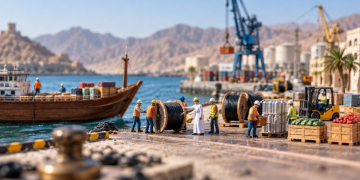
The IMF working paper — titled Alternative Trade Corridors of the GCC: The Case of IMEC — models the corridor as a sea–rail–sea route. Maritime legs connect to and from the Gulf. A rail leg crosses the Arabian Peninsula to European markets.
The authors translate changes in transit times and freight costs into bilateral trade costs using a structural gravity framework. The model finds that GCC countries and Jordan gain the most. Improved overland connectivity would expand their reach into Europe, North America and North Africa.
What does the IMF model show for investors?
The distribution of gains matters more than any headline average. The IMF’s sensitivity analysis shows that trade-cost outcomes shift sharply depending on relative freight rates and border conditions. Small changes in rail pricing or transit times can materially alter the corridor’s commercial effectiveness.
Rail costs are the key variable. Where rail freight rates exceed maritime equivalents, time savings alone may not drive route adoption. Transit delays compound this risk. The IMF paper finds that delays can substantially reduce both route uptake and aggregate gains across affected country pairs.
By FurtherArabia’s reading of the numbers, the investment signal is selective rather than universal. The corridor may support demand for intermodal terminals, inland distribution hubs and logistics platforms in the Gulf and Jordan. However, returns will depend on consistent operating times and competitive pricing.
| IMEC factor | IMF finding | Source |
|---|---|---|
| Primary beneficiaries | GCC countries and Jordan | IMF Working Paper, October 2026 |
| Key cost variable | Rail vs maritime freight rate spread | IMF Working Paper, October 2026 |
| Risk factor | Transit delays reduce route adoption and gains | IMF Working Paper, October 2026 |
Where does the opportunity lie for Gulf infrastructure capital?
Ports and logistics platforms able to serve multiple routes carry less volume risk than single-purpose infrastructure. Cargo handling efficiency and customs coordination will shape commercial uptake as much as track and terminal investment. This aligns with Mubadala’s stated long-term interest in India, where infrastructure and technology sit at the centre of a deepening bilateral agenda.
The broader context supports a positive read. Foreign direct investment into GCC economies rose 18% to roughly US$99B in 2025 — a reported decade high, as covered in GCC investment growth reaching a decade-high US$99B. That capital stock gives Gulf states the firepower to develop IMEC-linked assets without external financing pressure.
The IMF paper places execution at the centre of the investment thesis. Reducing administrative delays at borders could matter as much as building new rail capacity. Competitive pricing must accompany faster movement.
Corporate shippers will compare IMEC against established sea services on cost and reliability. The corridor offers a genuine alternative — not an automatic upgrade. Its value rises as rail rates, transit protocols and intermodal handling improve together.
Investors should monitor rail and sea freight spreads, border transit times and early evidence of route adoption as the corridor moves from planning to operation.
What it means for the Gulf
The IMF’s finding that GCC countries and Jordan stand to gain the most from IMEC reinforces a pattern visible across Gulf capital deployment: bilateral corridors are becoming structural rather than opportunistic. With UAE-Indonesia bilateral trade already reaching US$6.1B and a US$200B UAE-India trade target set for 2032, IMEC sits at the intersection of routes the Gulf is already building around.
The IMF’s emphasis on execution risk — rail pricing, border delays and intermodal coordination — aligns with the selective signal noted in the paper itself. As cross-border M&A reached US$494B in the first nine months of 2026, Gulf investors targeting logistics and port assets will need to price operational complexity, not just throughput potential.
Quick answers
The IMF model shows that high rail freight rates and transit delays are the main risks. Where rail costs exceed maritime rates, time savings alone may not be enough to drive route adoption.
The corridor supports demand for intermodal terminals, logistics platforms and inland distribution hubs across the GCC and Jordan. The IMF paper signals that flexible, multi-route assets carry less risk than dedicated single-corridor infrastructure.